
The Quick Answer: How to Choose the Best Relationship Support
For those seeking an immediate framework for selecting a premier couples therapist in Atlanta, clinical excellence is defined by these three non-negotiable pillars:
- Evidence-Based Specialization: Do not settle for a generalist. The “best” therapists for couples are specifically trained in research-backed models like the Gottman Method (Level 2 or 3) or Emotionally Focused Therapy (EFT).
- Clinical Experience & Advanced Licensure: Look for practitioners with years of experience and credentials such as LPC, LMHC, or CPCS.
- The “Success Paradox” Expertise: For Atlanta’s high-achievers, the best therapist understands how boardroom leadership skills (decisiveness, fix-it mentality) can inadvertently damage domestic intimacy and knows how to bridge that gap.
The Invisible Crisis in High-Achieving Homes
You walk into your bathroom, look in the mirror, and a sudden, jarring thought stops you cold: “What am I doing here?”
On the surface, your life in Atlanta might look exactly how you planned it—the career is thriving, the home in Buckhead or Brookhaven is beautiful, and your social calendar is full. But inside the walls of your relationship, something is fundamentally broken. You feel completely disconnected, like you’re living with a roommate instead of a partner. You find yourselves trapped in a loop, having the same exhausting arguments over and over again with no resolution in sight.
When you reach this “Crisis of Connection,” the stakes couldn’t be higher. Relationship health is the foundation upon which every other success in your life is built. In cases where the bond feels irreparably fractured, some may begin researching Atlanta divorce counseling to navigate the transition; however, for most high-achieving couples, the goal is restoration and the rebuilding of trust.
Yet, searching for “couples therapy Atlanta” yields hundreds of results. How do you distinguish a generalist from a true specialist? This guide is designed to help you navigate the overwhelming landscape of Atlanta marriage counseling, ensuring you find a therapist who offers more than just a “safe space,” but a research-backed path to transformation.
Section 1: Why “General” Therapy Often Fails Couples
One of the most common mistakes couples make is hiring a therapist who primarily treats individuals and “also sees couples” on the side. In the clinical world, this is a significant distinction that can impact your outcome.
The Relationship as the Client
In individual therapy, the client is the person in the chair. In couples therapy, the relationship itself is the client. This requires a completely different set of interventions and a high degree of “multi-directed partiality”—the ability of the therapist to stay allied with both partners simultaneously without taking sides.
Without specialized training, a generalist therapist can inadvertently make things worse. They may allow sessions to devolve into “he-said, she-said” venting sessions. While venting might feel cathartic in the moment, it often leaves both partners feeling more alienated and defensive than when they arrived.
The Danger of “Neutrality”

A common myth is that a therapist should be a neutral referee. In reality, the best couples therapists in Atlanta are active coaches. They should be able to identify the “Negative Cycle” in real-time and interrupt it..
Section 2: The Gold Standards—Gottman Method and EFT
When vetting a therapist, you should specifically look for training in “Gold Standard” modalities. These are frameworks backed by decades of longitudinal research rather than just clinical “opinion.”
1. The Gottman Method: The Science of Relationships
Developed by Drs. John and Julie Gottman, this method is based on 40 years of research with over 3,000 couples. According to the American Psychological Association (APA), this data-driven approach is among the most rigorous frameworks for relationship health in existence.
As a Level 3 Gottman Trained Therapist, I utilize Gottman Method couples counseling because it provides couples with a “Sound Relationship House.” We look at:
- The Four Horsemen: We identify and eliminate Criticism, Contempt, Defensiveness, and Stonewalling—patterns that Gottman’s research published in the Journal of Marriage and Family proves are the greatest predictors of divorce.
- Love Maps: We help partners rebuild their psychological knowledge of one another.
- The Shared Meaning System: We move beyond “getting along” to creating a life that feels purposeful and culturally aligned for both of you.
2. Emotionally Focused Therapy (EFT): The Logic of Attachment
EFT, developed by Dr. Sue Johnson, is based on attachment theory. It views relationship distress as a “protest against disconnection.”
When you find yourself arguing about the dishes or the schedule, an EFT-trained therapist recognizes that the argument isn’t actually about the dishes—it’s about the underlying question: “Are you there for me? Do I matter to you? Can I reach you?” Meta-analyses published by the National Institutes of Health (NIH) indicate that EFT has a high rate of success in moving couples toward “Secure Attachment.”
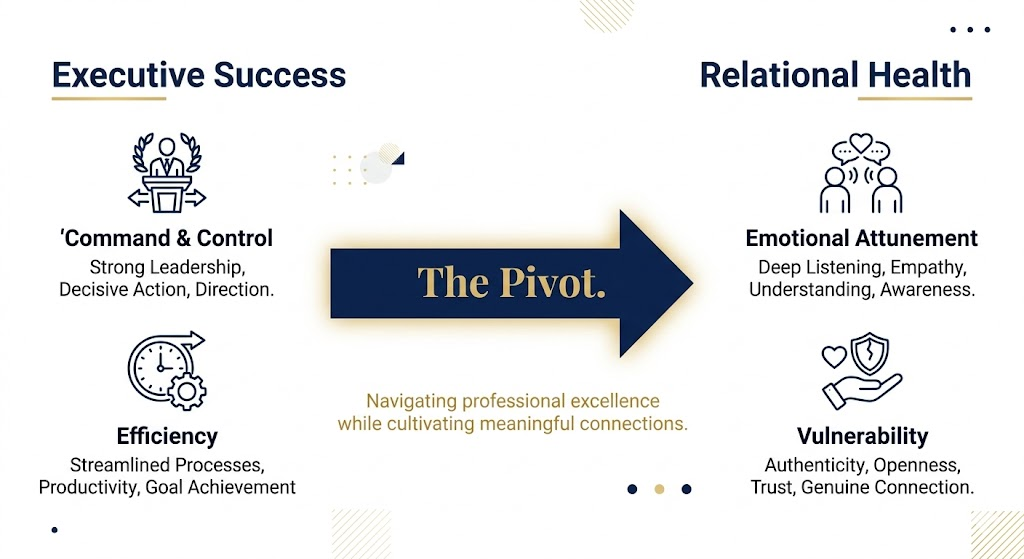
Section 3: The High-Achiever’s Dilemma—Boardroom Success vs. Relational Disconnect
In my 13+ years of experience as an Atlanta counselor, I have noticed a specific pattern among the city’s leaders, entrepreneurs, and executives. There is a “Success Paradox” that occurs in high-achieving relationships.
The CEO Mentality in the Living Room
The very traits that make you successful in Atlanta’s competitive business landscape—decisiveness, high expectations, and emotional compartmentalization—can be catastrophic in a marriage.
- The Problem: You try to “optimize” your partner or “manage” the relationship like a project.
- The Result: Your partner feels like a subordinate rather than a lover. This leads to deep resentment and emotional withdrawal.
This “spillover” effect is a documented phenomenon; research in the Journal of Business and Psychology explores how leadership behaviors and high-performance work environments can create “work-family conflict” that erodes relationship satisfaction. High-performance pressure at work often bleeds into the home, frequently requiring anxiety therapy in Atlanta to help individuals manage the internal drive that, while profitable in business, creates relational friction.
Shifting from Efficiency to Attunement
Because I worked in the business world prior to becoming a licensed therapist, I understand this dynamic intimately. High-achievers need a therapist who respects their drive but isn’t afraid to challenge the “command and control” style of communication killing the intimacy at home. We work on translating leadership skills into relational skills: emotional attunement, active listening, and soft startups.
Section 4: The 5-Step Vetting Checklist for Atlanta Couples
To ensure you are working with a premier specialist, I recommend a brief consultation call. Use these five criteria to vet your potential therapist:
1. Post-Graduate Certifications
Do not settle for “I’ve been doing this for a long time.” Look for specific certifications. Are they atrained in Gottman Method or EFT? For couples just starting their journey, premarital counseling in Atlanta using these models and Prepare Enrich can prevent years of future conflict.
2. Cultural and Spiritual Humility
Atlanta is a diverse hub. Whether you are navigating intercultural dynamics or Southern spiritual traditions, your therapist must demonstrate Cultural Humility. You shouldn’t have to spend your sessions educating your therapist on your worldview.
3. Structured Assessment
The best therapists don’t dive into “fixing” in session one. They use tools like the Gottman Relationship Checkup or intensive intake interviews to create a clinical treatment plan.
4. The “Relational Fit”
While credentials are the “hard skills,” the “soft skill” of the therapeutic alliance is the #1 predictor of success.
- Do I feel seen? Does the therapist work to understand your perspective without judgment?
- Do I feel safe? Vulnerability is the engine of change.
Section 5: Logistics—Rates, Location, and the ROI of Therapy
The ROI of Relationship Repair
Specialized therapy is an investment. Veteran therapists with advanced certifications charge higher rates because of the Return on Investment.
- The Financial Reality: The cost of a clinical intervention is a fraction of the cost of divorce, which CNBC reports can range from $15,000 to over $100,000 depending on complexity.
- The Emotional Reality: A “high-conflict” home affects your physical health, your performance at work, and the well-being of your children. If you find your mood consistently low, you may also benefit from depression treatment in Atlanta to stabilize your emotional foundation while working on the relationship.
The Atlanta Factor: Virtual vs. In-Person
Between the traffic on I-75 and demanding schedules, many professionals are opting for online counseling and teletherapy.
- Flexibility: Work with a specialist from your office without the 45-minute commute.
- Privacy: No sitting in a waiting room where you might run into a colleague.
- Effectiveness: Evidence curated by the American Telemedicine Association (ATA) confirms that virtual therapy is just as effective as in-person therapy for most clinical populations.
Section 6: Meet the Specialists at Rise Counseling
Our practice is dedicated to the belief that every couple has the capacity to rebuild if they have the right tools. We don’t just “talk”; we build skills.
Mikela Hallmark, MS, LPC, LMHC, CPCS
Founder & Counselor
With over 13 years of experience, Mikela brings a unique blend of clinical expertise and business understanding.
- Licensure: Licensed in both Georgia and Florida.
- Specializations: Gottman Method (Level 3), EFT, and EMDR therapy in Atlanta for trauma.
- Core Focus: Helping couples navigate communication challenges, lack of connection, relationship infidelity and high-stakes professional pressures.
Karen Michael, MS, LPC, NCC
Couples Specialist
Karen focuses on creating a safe harbor for couples in high distress, specializing in anxiety management and trauma-informed care.
Conclusion: Your First Step Toward Reconnection
Admitting that your relationship needs support isn’t a sign of failure—it is the ultimate act of leadership for your family. Whether you are looking for a Gottman-trained therapist in Buckhead or a virtual specialist, the right support is available.
Are you ready to rebuild?
If you’re wondering if one of our therapists would be a good fit, we invite you to reach out for a consultation. We would be honored to answer your questions and help you determine the best path forward for your relationship.
[Schedule Your Appointment Today]
About the Author:
Mikela Hallmark is a Licensed Professional Counselor (LPC) in Georgia, a Licensed Mental Health Counselor (LMHC) in Florida, and a Certified Professional Counselor Supervisor (CPCS). As the founder of Mikela Hallmark & Associates in Atlanta, she specializes in working with high achievers to overcome anxiety, trauma, and performance barriers. She holds a Master of Science (MS) in Community Counseling and is dedicated to evidence-based, compassionate clinical care.
Medical Disclaimer: The information in this guide is for educational and informational purposes only and does not constitute medical advice, diagnosis, or treatment. Always seek the advice of a qualified mental health professional or physician with any questions regarding a medical or psychological condition. If you are experiencing a mental health emergency, please contact 988 (in the USA) or your local emergency services.